Skills Overview

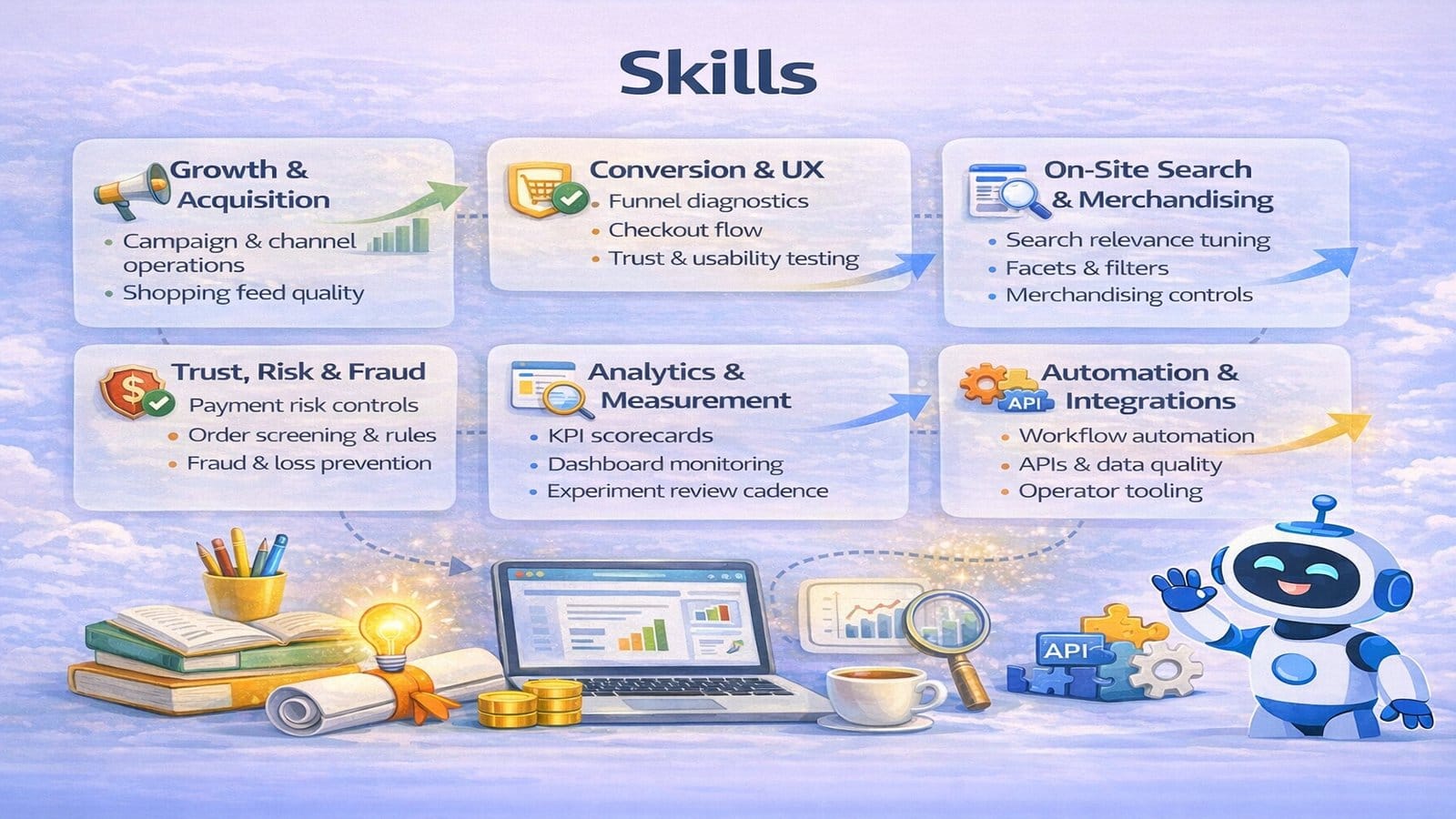
I build and operate practical ecommerce systems. It is a readable map of what I actually work on, how I think about it, and where to find supporting notes, playbooks, and case studies.
1) Growth and acquisition operations
Focus
I treat growth as an operating loop: attract qualified demand, land it on the right experience, measure the gaps, and iterate.
What I do in practice
I keep acquisition clean and measurable, with a strong handoff into on-site discovery and conversion. The goal is not "more traffic" - it is demand that converts profitably.
Core skills
Campaign and channel operations - structure, hygiene, iteration cadence
Feed quality and attribute coverage for shopping channels
Landing page alignment - intent, inventory, margin
Budget pacing and performance monitoring - with anomaly detection
Experiment planning and prioritization - with basic instrumentation
Supporting links
All Case studies
Marketing topics
2) Conversion and UX (including checkout)
Focus
Conversion improves when shoppers can find answers fast, trust the store, and complete checkout without friction or surprises.
What I do in practice
I diagnose where the funnel leaks, remove the most expensive friction first, and tighten the purchase path end-to-end.
Core skills
Funnel diagnosis - where users drop, where intent breaks, what to fix first
Findability and navigation logic - clear paths, fewer dead ends
Checkout flow quality - form friction, validation, error handling, recovery
Trust cues - shipping, returns, guarantees, expectations
Testing and iteration - small changes, measured outcomes, repeatable wins
Supporting links
Checkout & Orders topics
Usability topics
3) On-site search and merchandising
Focus
Search is a revenue system, not a feature. When search works, shoppers self-serve, AOV rises, and support load drops.
What I do in practice
I build search around relevance, ranking, and recovery. I also add operator controls so merchandising can steer outcomes without breaking logic.
Core skills
Relevance tuning - synonyms, stemming, typos, intent patterns
Facets and filters - shopper-friendly and SEO-safe
Zero-results recovery - fallbacks, suggestions, safe navigation paths
Ranking signals - inventory-aware and margin-aware ordering
Merchandising controls - hero slots, badges, bundles, complements, rules
Measurement loop - query dashboards, zero-results heatmaps, ranking tests
Supporting links
Search and Merchandising case study
Search & Discovery topics
4) Trust, risk, payments, and fraud
Focus
Risk is a two-way road: protect against fraud and loss while keeping approvals high and the customer experience smooth.
What I do in practice
I design risk controls as a routing system: what gets auto-approved, what gets reviewed, and what gets blocked - with clear reasons and fast operations.
Core skills
Pre-capture screening - IP geo, proxy/VPN signals, velocity, lists, device and behavior hints
Rules and routing - auto-release vs review, thresholds, exception handling
Address and delivery risk - mismatch patterns, validation, shipping constraints
Payment performance - decline analysis, false declines, approval rate lift
Operational workflows - review queues, feedback loops, rule maintenance
Supporting links
Order Risk Rules Engine case study
Trust & Risk topics
5) Analytics, measurement, and operating cadence
Focus
Measurement should drive weekly decisions, not produce dashboards that nobody acts on.
What I do in practice
I define KPI scorecards, keep signals consistent, and run a review cadence that turns metrics into actions.
Core skills
KPI definition and scorecard design - trends, segments, leading indicators
Funnel and cohort views - diagnosis and prioritization
Search, checkout, and risk diagnostics - focused monitoring and thresholds
Experiment measurement - readouts that connect change to outcome
Weekly rhythm - review agenda, owners, next actions, follow-through
Supporting links
6) Automation, tooling, and integrations
Focus
Automation should remove repetitive work, reduce variance, and make operations more reliable - without turning the stack into a fragile science project.
What I do in practice
I automate workflows around data movement, QA guardrails, operational routines, and lightweight operator tooling.
Core skills
Workflow automation - reliability checks and clear fallbacks
Data quality validation - rules, guardrails, repeatable QA
APIs and integrations - practical glue between systems
Dashboards and operator tools - decision support, not vanity metrics
Documentation - playbooks and notes that keep work repeatable