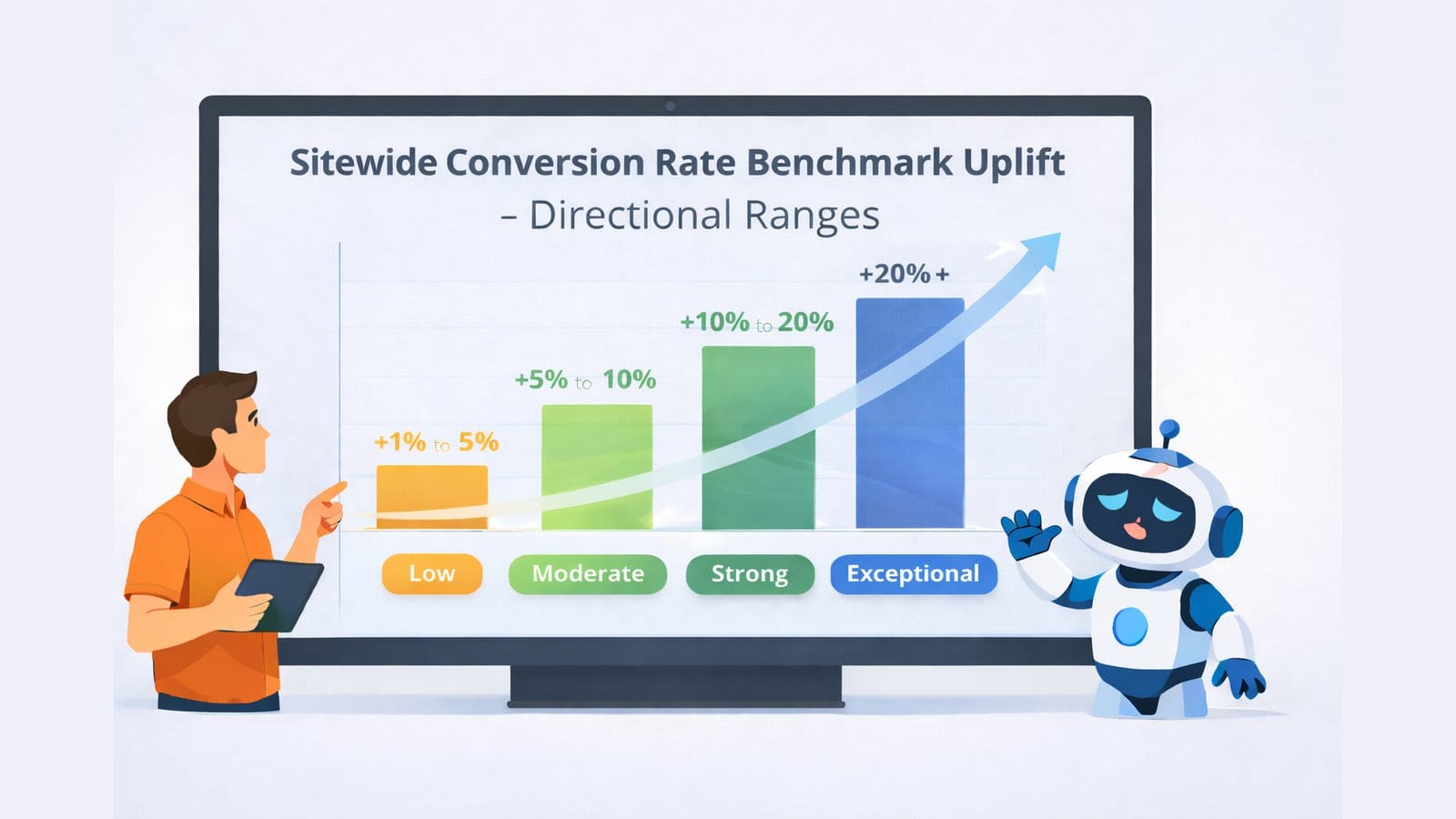
Sitewide Conversion Rate Benchmark Uplift - Directional Ranges Playbook

Purpose
Use these directional uplift ranges to size opportunities, prioritize tests, and set realistic expectations for sitewide conversion rate impact.
How to use
- Treat ranges as directional and context-dependent
- Use the lower end for small iterations and mature programs
- Use the upper end for larger redesigns, major fixes, or when fundamentals are broken
- Validate with A/B tests and segment analysis (device, channel, new vs returning)
Directional uplift ranges by factor
- Checkout flow optimization (single-page) - 5-20%
- Ratings and reviews (UGC) - 5-15%
- Performance optimization - page speed - 5-10%
- On-site search relevance and UX - 2-8%
- Product recommendations - 5-11%
- Product video assets - 1-4%
- Rich product imagery (3-7 images) - 1-3%
- Usability and interaction design - 5-15%
- Product quick view (PLP) - 0-2%
- Urgency messaging - countdown timers - 1-5%
- Promotions - coupons and discount codes - 2-8%
- High-quality product descriptions - 2-5%
- Product listing ranking algorithm (PLP sorting) - 2-6%
- Faceted navigation (layered filters) - 2-7%
- Payment authorization optimization and fraud controls - 2-8%
Notes
- “Sitewide” means the effect after traffic mix and page-type distribution are accounted for
- Some initiatives stack poorly (overlapping impact) - model combined uplift conservatively
- Track guardrails - AOV, margin, refund rate, chargebacks, and latency