Risk and Trust in E-commerce: The Two-Way Road

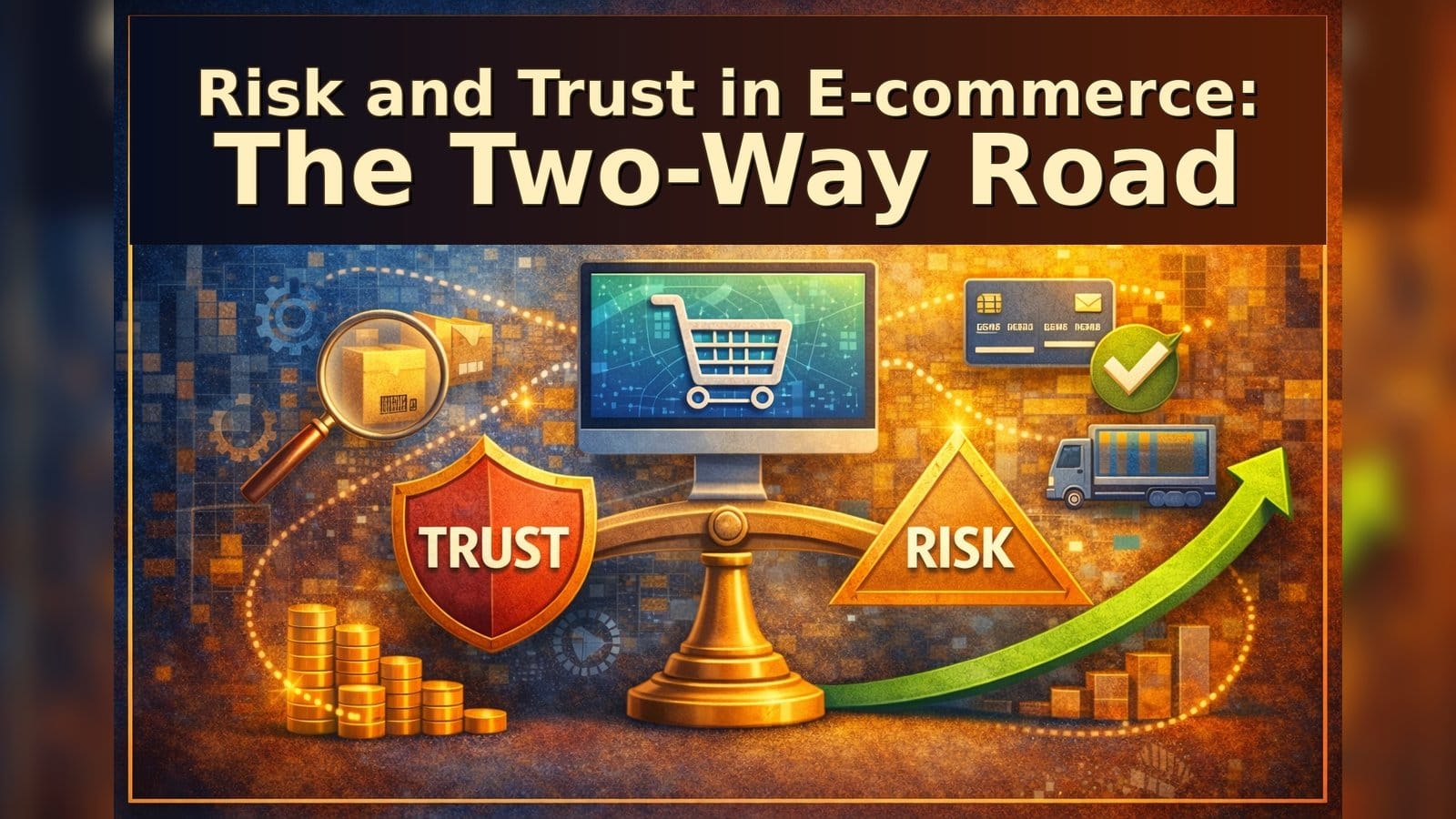
E-commerce is a business built on exchange under uncertainty.
A buyer wants a product. A seller wants money.
That deal sounds simple until you remember what online changes. The two sides do not see each other. The product cannot be touched. Money and goods move on different timelines. Delivery involves third parties. And if something goes wrong, the return or refund has to travel back.
This is not a story about an e-commerce website. It is a story about an e-commerce business.
Trust here is not an emotion. Trust is the operating system that keeps the exchange safe and affordable - for both sides.
The map (one picture to keep in your head)
Think of e-commerce as one exchange happening on a two-way road, inside a three-sided system.
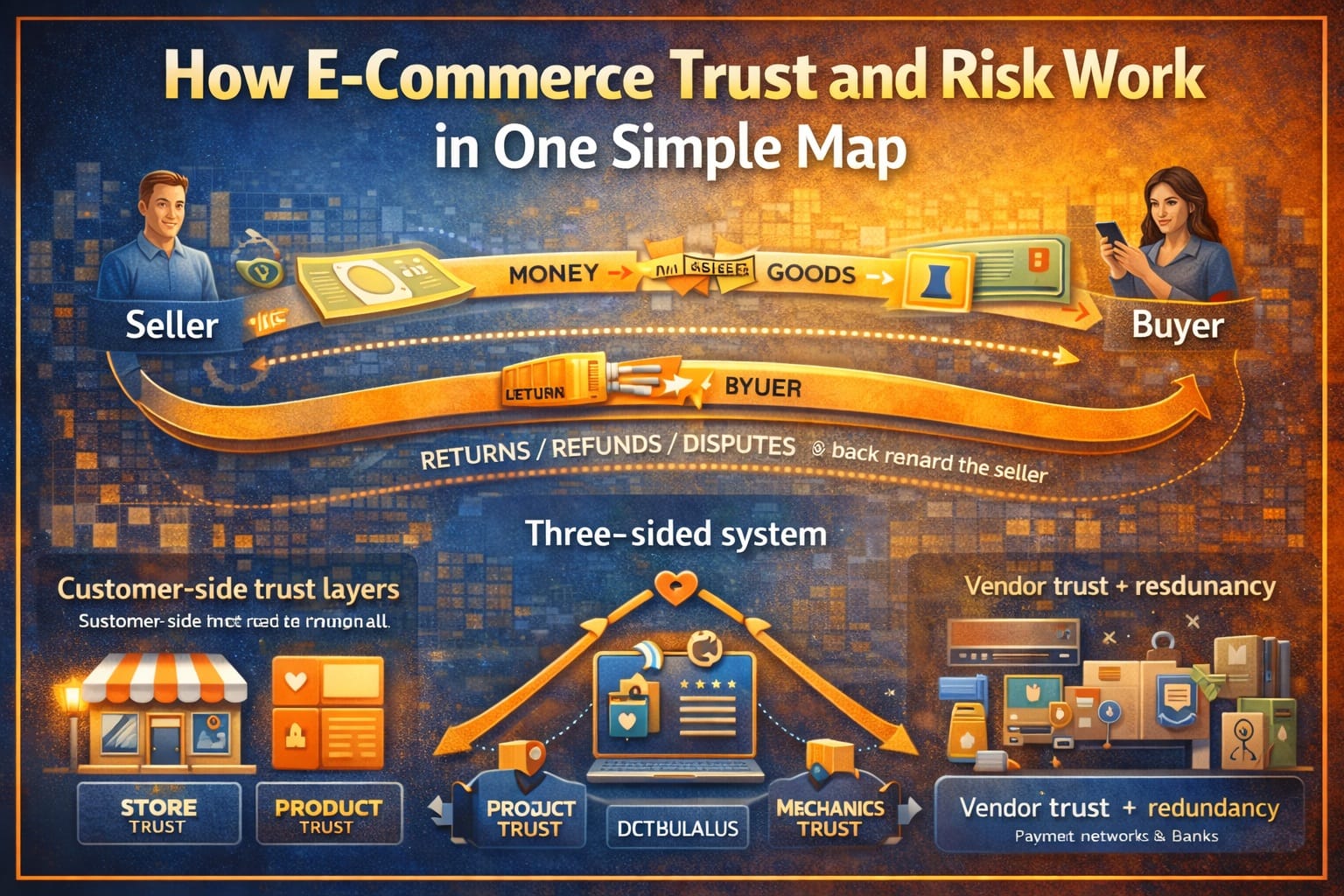
Two-way road (what moves): Money -> Seller Goods -> Buyer Then the return lane: returns, refunds, disputes -> back toward the seller
Three-sided system (who shapes outcomes): Buyer <-> Seller <-> Vendors Vendors = ad platforms, payment networks/banks/processors, carriers, fraud/address tools, distributors, other service providers
Customer-side trust layers (how the buyer decides to proceed): Layer 1: Storefront trust - what kind of store is this? Layer 2: Product trust - what am I buying? Layer 3: Mechanics trust - if something goes wrong, what happens next?
Merchant-side layer (what the seller must trust to deliver): Vendor trust + redundancy (no single point of failure)
If you keep this map in mind, every section below is just one part of it.
Trust systems are run by roles
It is easy to talk about "the seller" as if it is one entity. In reality, the seller is a set of job roles.
Trust and risk are not managed by slogans. They are managed by decisions.
A payment is declined. An AVS check does not match. A package is marked delivered but the customer says it is missing. A chargeback arrives with a deadline. A vendor breaks something and denies it.
In every case, the question is the same: Who owns the decision, what evidence is required, and what happens next?
When ownership is fuzzy, trust controls become inconsistent. Messaging conflicts. Exceptions fall through. Disputes turn into expensive chaos.
This is why automation - especially AI automation - often dies in production. It works in the happy path, then collapses on edge cases because nobody defined who approves what, what evidence counts, where the handoff goes, and how disagreements are resolved.
AI can accelerate parts of the work. But it cannot replace missing clarity. Without explicit job roles and decision boundaries, you do not get automation. You get faster ambiguity.
Roles do not stop at the company boundary. Vendors have roles too. And the customer is a role in the system, not just a person on the other side of the screen.
We give that role an interface and a set of responsibilities: search, choose, enter data, authorize payment, receive delivery, request a refund, and recognize a charge on a statement. When these roles and their boundaries are not explicit, you do not get trust. You get confusion.
There is one more layer people often ignore: internal trust. Inside the merchant, trust and risk also exist between employees and systems.
Who can see sensitive data. Who can change an address after checkout. Who can approve a refund or override a fraud hold. Who can edit logs or suppress alerts.
Without clear access boundaries and auditability, you do not just risk external fraud. You risk internal mistakes, abuse, and silent policy drift. And the customer will still experience the outcome as a trust failure of the store.
A simple place to see this chaos is the FAQ. On many sites, the FAQ is vague, incomplete, or evasive. It avoids hard scenarios. It does not explain what happens when things go wrong.
That is not a content problem. It is a role and policy problem. The company is afraid to say something precise because it does not have precise ownership, rules, and boundaries behind the scenes.
This is why naive "AI customer service" often disappoints. A chatbot cannot automate clarity that does not exist. If policies and exception-handling are not explicit, the bot will simply scale the same ambiguity. It will be as good as the system it is allowed to represent.
It is like asking "What key are we in?" and hearing "Just start playing."
Storefront trust - what store am I in?
A customer makes a judgment before they evaluate your product. They evaluate your store.
They look for signals: Policies that make sense. Support that is reachable. Consistency across the site. Predictable fulfillment and communication.
Offline analogy: a big chain store versus a sketchy storefront. Even if the product is the same, the perceived risk is not.
This is why details matter. They are not decoration. They are trust signals.
A useful way to think about the storefront is simple. It is not there to impress. It is there to reduce uncertainty and prevent misunderstandings about what is being sold and what will happen after purchase.
Product trust - what am I buying?
Now the customer asks a different question. Not "Can I trust this store?" but "Can I trust this item?"
Brand reputation is the strongest shortcut. Known brands reduce uncertainty. Unknown brands increase it.
Marketplaces understand this deeply. They lend trust. When a platform has strong guarantees, customers will buy from brands they have never heard of.
Product content is also a trust mechanism. Good photos. Accurate specifications. Clear expectations. A listing that feels real.
Mechanics trust - will the deal work out?
Even if the store looks legitimate and the product looks solid, the deal can still fail.
Because the customer is not buying only an item. They are buying an outcome.
This is why checkout is not just a form. It is a place where input quality is enforced. Small data issues at purchase time tend to reappear later as expensive exceptions: verification failures, delivery problems, extra support, and disputes.
Will I get the right thing? Will it arrive? Will it arrive intact? If I am unhappy, can I undo the decision?
This layer includes the mechanics that make e-commerce possible: Payment safety. Delivery. Returns and refunds. Dispute resolution.
It is also where many hidden risks live.
Platforms and suppliers: trust you borrow
So far we looked at trust between buyer and seller. But merchants also operate inside an ecosystem of vendors. And many of those relationships are built on trust under uncertainty too.
Advertising is a good example. With modern Google Ads, it can be hard to explain why traffic shows up the way it does. The platform optimizes inside a black box: targeting, auctions, attribution, and creative selection are increasingly automated. You set a goal and a budget, and the system decides what to do. Sometimes it even nudges you toward fewer controls: "give me fewer constraints, I will do it better".
That is a form of vendor trust. Not emotional trust - operational trust. You are delegating a material part of your revenue engine to an opaque system.
This kind of vendor opacity is not limited to advertising. Search, recommendations, and other AI-driven catalog systems can become black boxes too. When you cannot explain outcomes, you lose the ability to debug and improve them with confidence. So you manage it the same way you manage any vendor: clear objectives, monitoring, guardrails, and a feedback loop based on outcomes.
Suppliers create a similar trust layer. A product listing is a promise, but the real risk often sits upstream. Will the distributor ship what you expect? Will the quality match last month? Will lead times slip?
Customers will blame the store either way. So the merchant ends up converting vendor uncertainty into customer trust.
Payments: third parties, black boxes, and buyer-first protection
Payments are the first major place where the two-way road meets intermediaries. The buyer and seller are not dealing with each other directly. They are dealing through a stack of financial middlemen.
Between buyer and seller sits a stack of intermediaries: checkout gateway, payment processor, card network, the acquiring bank on the merchant side, and the issuing bank on the customer side. Each of them runs its own risk rules.
This is why perfectly legitimate orders sometimes fail. A bank may decline a transaction because it looks risky. A processor can flag an order incorrectly. A cross-border purchase, a new device, a mismatch of address signals - any of these can trigger a false decline.
And the most frustrating part is: declines are a black box.
Merchants rarely get a real reason. Even when a message exists, it is not reliable or standardized across issuers. Sometimes the response is intentionally vague. Sometimes it is simply wrong.
So the only honest thing you can tell a customer is: your card was declined. And both sides are stuck - the customer does not know why, and the merchant cannot diagnose it.
In practice this becomes a strange customer support moment. The customer is asking for an explanation. The merchant has none.
Here is the operator reality. In our long-run store data (remarkably stable over about a decade, across multiple processors), roughly 10% of payment attempts are declined somewhere in the payment chain. Separately, about another ~10% of created orders end up canceled later - primarily because we cannot verify the customer with enough confidence to safely ship. The most common pattern is simple: we try to contact the customer, and they go silent.
This is the hidden tax of remote commerce. A meaningful slice of outcomes is decided by intermediaries and by the limits of what you can confidently verify at a distance.
Address Verification is a good example. You can get an AVS mismatch even when the customer types their billing address correctly. The issuing bank may have a formatting error in its records: a truncated apartment number, a missing digit, a shifted ZIP code, or a non-standard abbreviation. From the merchant side, there is no way to see what the bank thinks the "correct" address is.
If you accept the order, you may eat fraud. If you reject it, you may lose a perfectly good customer. Either way, the payment intermediary just forced a tradeoff.
There is also a structural asymmetry here. In most chargeback flows, the issuing bank primarily represents its cardholder. The buyer is the bank’s customer. The merchant is not.
So the default posture often feels like: the buyer gets the benefit of the doubt, and the seller must prove innocence with evidence, timelines, delivery proofs, and documentation - within strict deadlines.
That proof work is not abstract. It is a dispute process with forms, deadlines, and partial visibility. You are reconstructing a transaction from logs, emails, tracking events, and policies - and you often learn about the dispute after the customer has already decided the story.
This is what production looks like in commerce. It is evidence work across systems, under deadlines, with messy edge cases the happy-path flow never mentions.
A surprisingly practical detail matters here. If the customer cannot recognize the charge on their statement, you are already behind. The descriptor, the website name, and the phone number on the statement need to be accurate and alive. If a customer can search the name or the phone number and immediately find the real store, a large class of "I don’t recognize this" chargebacks never happens. When they cannot, confusion turns into a dispute.
And this is where roles become real. A dispute is not just a policy. It is a coordinated response across people and systems: support, fraud review, fulfillment, and accounting working from the same evidence and the same rules. When that coordination is weak, even a simple chargeback becomes expensive chaos.
And even beyond issuer declines, risk continues after an order is created. Sometimes the safest way to prevent chargebacks is simply not to ship. If an order triggers risk signals and the customer goes silent - no reply to emails, no call back, no confirmation - the merchant is forced to cancel, even if the order might be legitimate.
This is the hard part of e-commerce. To a seller who is about to ship a physical product, a fraudster and a silent honest customer can look identical.
Delivery risk: the third party in the middle
Shipping introduces a new set of failures: The item was not shipped. The item was shipped but delivered to the wrong address. The carrier made an error. The package was stolen. The customer says it never arrived.
What makes this extra frustrating is that modern delivery can be far more provable than it often is. In many cases the carrier could provide precise drop-off coordinates, a photo of where the package was left, and a clear event trail when it was not handed to a person. Technically, this is not hard. Yet it is inconsistently available - sometimes for privacy reasons, sometimes for policy reasons, sometimes simply because the carrier workflow was not designed for it.
The result is a predictable baseline loss. On a hundred packages, one or two will turn into an investigation. That sounds small until you are the seller handling the replacement decision in real time: do you reship now to protect the relationship, or wait for a claim process that may take days. Either choice has a cost.
And theft is a real contributor to this baseline, not a rare anecdote.
Notice something important. Not all problems are fraud. Many problems are normal operational failure.
A good trust system separates these cases.
Returns and refunds: the return lane that keeps the highway open
Returns are often treated as a cost. But returns are also a trust tool.
They let customers take a risk on a purchase. They reduce hesitation. They make the exchange feel reversible.
If your return lane is broken, the entire two-way road becomes dangerous. Customers feel trapped. They do not buy.
Risk controls are the receipt check at the exit
The payment system already has its own controls. The carrier has its own controls. And yet merchants still need controls of their own. Not because customers are bad, but because remote commerce creates edge cases that someone has to absorb.
Offline analogy: the receipt check at the exit. It is a control, but it is also a social contract. Most people pass through without friction. A small number of cases get a second look.
Online, good risk controls should feel the same.
They are progressive. Most orders flow through. Only a small slice gets extra steps.
They focus on behavior and context. Not who the customer claims to be, but what the transaction looks like: velocity, inconsistencies, unusual patterns, and weak verification signals.
They keep the "good customer" experience intact. False positives are real damage. When you add friction, you do it only where it reduces losses more than it kills conversion.
And when an order needs verification, the goal is clarity, not accusation. Simple confirmation steps, clear messaging, and fast resolution keep trust intact even when you say "not yet".
Not every customer should be happy
There is a popular slogan: "the customer is always right". In e-commerce, taken literally, it is a fast way to go broke.
The goal of a business is not maximum happiness at any cost. The goal is sustainable profit. That requires balance.
In practice, profit is often protected in the long tail. A small number of high-friction, high-loss interactions can consume disproportionate time and money. If you subsidize them indefinitely, the cost is paid by everyone else.
You protect good customers by refusing to subsidize bad behavior. Abusive communication, repeated dishonesty, and chargeback abuse are not "feedback". They are risk signals.
In practice, mature merchants set boundaries. They document incidents, tighten terms, and in some cases choose to stop doing business with a customer. The same principle applies to vendors. If a carrier, processor, or supplier repeatedly creates avoidable damage, you reduce exposure or replace them.
This is not about being harsh. It is about keeping the system viable so that the honest majority can get reliable service at a fair price.
Post-purchase is where trust becomes real
Most e-commerce teams obsess over acquisition and checkout.
But trust is decided later.
When the package arrives. When it matches expectations. When support answers. When a refund is handled cleanly. When a dispute is resolved.
A single bad post-purchase experience can destroy all storefront trust overnight.
Takeaway: trust is designed, measured, and tuned
Trust is not a slogan. It is an operating system for exchange under uncertainty.
You design it with policies, content, payment rules, shipping processes, and resolution workflows.
You measure it with outcomes: disputes and chargebacks, refund rates, delivery exceptions, repeat purchase, and support contacts per order.
And you tune it constantly.
Because commerce is a two-way road. And your job is to keep traffic moving in both directions - safely.
References
- Merchant Risk Council (MRC), Visa Acceptance Solutions, and Verifi. 2025 Global eCommerce Payments & Fraud Report (PDF, Apr 4, 2025):
https://www.visaacceptance.com/content/dam/documents/campaign/fraud-report/global-fraud-report-2025.pdf - U.S. Postal Service Office of Inspector General. Package Theft in the United States. White Paper. Report Number RISC-WP-25-002 (PDF, May 15, 2025): https://www.uspsoig.gov/sites/default/files/reports/2025-05/RISC-WP-25-002.pdf