Niche E-commerce: The Line of Death and the AI Illusion

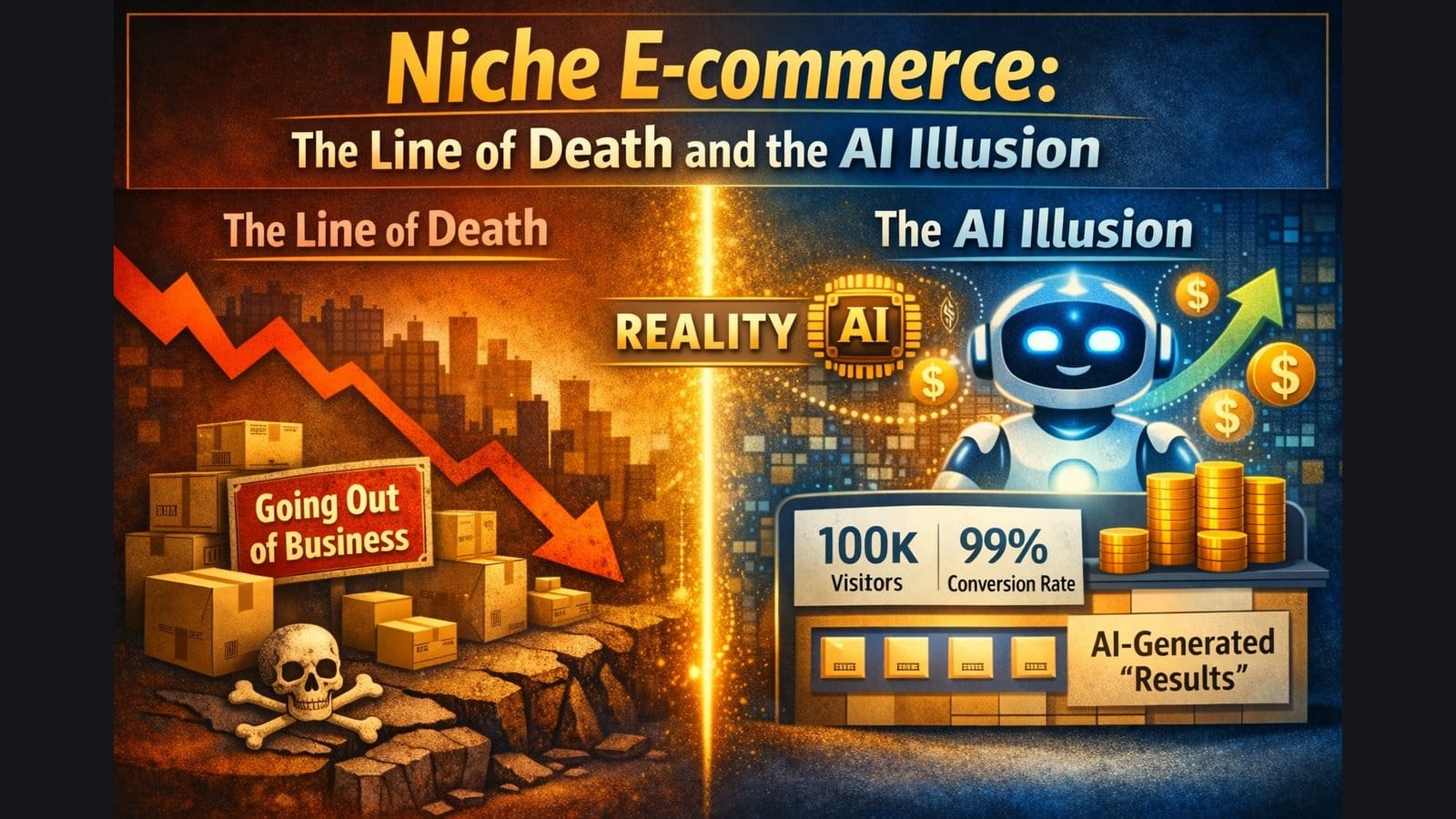
This article is about a specific band of businesses.
It is about established niche commerce brands that are real operators but not giants.
Typical signs:
A catalog measured in thousands of parent products (not hundreds, not millions).
Variants may multiply that into several times more SKUs.
A stable assortment where changes are incremental, not daily reinvention.
Revenue measured in the tens of millions, not hundreds of millions.
A real customer base built over years.
A small number of serious competitors in the niche.
These businesses sit in the hardest position.
They are large enough that inconsistency, manual work, and tool sprawl become expensive.
But they are not large enough to buy scale advantages in shipping speed, price, or engineering headcount.
The pressure is structural
Amazon set the standard: low prices, fast delivery, and enough information and reviews to buy.
China-based platforms add another pressure layer: extreme price competition and endless assortment.
Large operators also have access to capital that most niche brands do not.
They can afford to burn money in a category to gain share, set expectations, and squeeze smaller players.
Another scale advantage is talent: large operators can hire stronger specialists than most mid-sized niche brands can.
In this environment, many established niche businesses are simply in line for decline.
Without a change in strategy and operating discipline, it is a matter of time.
Why customers still buy from niche sites
If a niche brand can not win on pure scale, the question becomes: why do customers still buy there.
The answer is rarely a feature.
It is trust built over years.
Familiarity.
A sense that the seller understands the niche.
Confidence that the product will be right for the use case.
A belief that problems will be handled fairly.
Sometimes it is simply habit: customers return because they bought there before.
This is not sentiment. It is an economic asset.
That is also why today’s marketing is not only acquisition. It is trust maintenance.
Every interaction, every delivery, every return, every answer, every product page either compounds trust or burns it.
The AI hope, and why it is often misplaced
AI arrived and created a familiar hope: a new tool will solve a structural problem.
For this business band, the hope usually takes the same form: “if we adopt AI, we will become competitive again.”
This is where expectations drift.
What AI can do is narrower.
Common myths about AI in e-commerce
Myth 1: AI will fix fundamentals
AI does not change the fundamentals that decide competitiveness.
It will not make your products cheaper.
It will not make your shipping faster.
It will not create the kind of customer trust that takes years to earn.
Myth 2: AI replaces software
Software is faster, cheaper, predictable, and easy to test.
AI should fill gaps where deterministic systems do not exist or where the manual cost is high.
Myth 3: AI agents will build complex applications by themselves
Any real application does not live in a vacuum.
It sits on a stack of frameworks, libraries, SDKs, integrations, APIs, admin tools, logs, CLI utilities, and manual processes.
This entire world was built before the era of AI agents and was designed for one primary scenario: a human specialist reads documentation, understands context, keeps constraints in mind, and connects the pieces by hand.
Agentic programming is trying to layer a new working style on top of that old infrastructure.
But the infrastructure is not ready for it.
Why.
Interfaces are built for human intuition, not autonomous execution
Function names, parameters, error behavior, and implicit assumptions are often "obvious if you have experience", but they are not formal contracts.
An agent has to guess.
Guessing in production is risk.
There is too much hidden context
A human knows: "do not hit this endpoint too often", "this field is sometimes empty", "this vendor sends junk on Mondays", "after deploy you must do this step".
None of that is in code or in the API.
It lives in habits and tribal process.
Without that context, an agent does not "build a system".
It builds surprises.
APIs and integrations are either too thin or too noisy
Often they do not provide what safe automation needs: metadata, clear statuses, reasons for failure, consistent error codes.
Or they flood you with noise: huge JSON payloads, semi-structured fields, giant logs.
That burns tokens and dilutes signal.
What a human can scan and understand quickly becomes expensive and unreliable parsing work for an agent.
Most stacks lack agent-native safety and verification loops
The old world assumes a human will not do something catastrophically wrong because the human understands consequences.
With agents you need a different posture: explicit constraints, validation, sandboxing, dry-run modes, approvals, observability, and rollback paths.
Most tools and processes are not built that way by default.
The maintenance nightmare: agent-written code is still someone else's code
For most programmers, the worst work is not writing code. It is understanding someone else's code.
Because code is not just instructions for a computer. It is a frozen model of how the author thought the world works: how the system was split into parts, what assumptions were made, which exceptions were considered important, how things were named, what was treated as obvious, and what was never written down.
Now add AI agents.
An agent can generate a lot of code quickly, but it brings its own internal logic: odd abstractions, random module boundaries, unstable style, inconsistent naming, and implicit assumptions.
And most importantly, this often does not match how the system must evolve inside a real business.
The result is a new kind of technical debt: not "someone else's code", but "someone else's code with no author".
With a human you can ask: why did you do it this way, where are the boundaries, what are the guarantees, what cases did you consider.
With an agent, there is no why. There is only text that looks plausible.
And if that code is not already a clean, well-designed solution, the expensive work begins.
An engineer has to spend time not creating value, but reconstructing context that never existed in their head.
The agent's context disappeared after generation.
That is why agent-written production code becomes a win only under strict discipline: standards, architecture boundaries, tests, contracts, and a process that turns drafts into maintainable systems.
Otherwise, generation speed becomes the speed of accumulating a maintenance nightmare.
Responsibility does not disappear
One more point matters more than the tooling.
In any real system, someone is responsible for outcomes and consequences.
An AI agent can generate code, but it can not hold responsibility.
When something breaks, leaks money, creates a compliance issue, or harms customers, the business still owns the result.
That is why agentic work requires explicit ownership: who approves changes, who monitors behavior, who can stop it, and who is on the hook when it goes wrong.
If you can not name the owner, the automation will either never ship, or it will ship and die the first time it causes damage.
Practical summary
Agents can speed up drafts and prototypes.
In demos it looks easy. In production you hit a style mismatch: agents need structured context, contractual interfaces, and predictable behavior.
The surrounding software world is human-built, historically layered, and full of implicit rules.
But production systems are built on contracts, shared assumptions, and long-term ownership.
If the surrounding stack is human-built and full of implicit context, agents will struggle unless you rewrite that context into explicit rules.
If no one owns outcomes, agents can not be deployed safely.
If no one can maintain the generated code, speed turns into a maintenance nightmare.
That is why the promise that "agents will build complex applications by themselves" keeps breaking on reality: the limitation is not only the agents. The world they must operate in was not built for them.
Myth 4: AI replaces people by itself
Reducing labor is the real ROI at this scale, but it is not automatic.
You still have to map the work, extract the rules, define exceptions, and build controls.
Without that discipline, you do not remove people. You create new failures.
Myth 5: AI chat and AI personalization for product discovery
Myth: “AI chat and personalization will help customers find the right product.”
Reality: product discovery is not a one-shot question. The customer often does not know what they need, and the site does not know what the customer means.
The real constraints (micro-facets) appear only during interaction: the customer browses a listing, applies a filter, sees options, reacts, changes direction, compares, and learns what matters.
A chat bot can not run that loop for them, because it is not the customer. It is not inside their head, and it can not see intent evolving in real time as the customer sees real products. The real work is making browsing, filtering, and comparison so fast and clear that customers can run their own discovery loop without friction.
Myth 6: AI will replace customer service
Myth: “We will replace customer service with an AI chat bot or a voice bot.”
Reality: in a healthy e-commerce business, customer service is not a feature. It is a red signal.
Most customer contacts exist because something upstream failed: unclear product information, wrong expectations, delivery uncertainty, broken tracking, confusing returns, missing order status, inconsistent policies, or edge cases the site can not explain.
Adding AI on top does not remove the failure. It adds a new interface that can only do two unsafe things at scale: repeat generic text or guess. Repeating is friction. Guessing is trust damage.
That is why “AI customer service” is often a misplaced goal. If the business is generating preventable questions, a bot will not fix the system. It will amplify the chaos.
Myth 7: AI makes A/B testing easy because variations are cheap
Myth: “With AI we can generate lots of variants fast - on the site and in ads - and then quickly pick the winners.”
Reality: AI does make variants cheap and fast to produce. It does not make learning cheap.
A/B testing is limited by statistics, not by content production speed.
Most businesses do not have enough clean volume to detect small uplifts with confidence - in ads or on-site - especially when seasonality, audience shifts, channel mix, and daily noise move performance more than the variation itself.
AI can accelerate variation. It can not guarantee a signal.
And without a signal, you do not get optimization. You get activity.
What AI actually changes in practice
In this business band, AI changes one thing that matters: labor economics.
It can reduce how many people you need to run the same machine.
Not by optimizing the market.
By turning routine work and exception handling into explicit rules, checklists, and automations.
In a mature niche business, most things already work well enough, or the business would have died years ago.
The real cost is labor: the people required to keep routine and exceptions moving.
The practical use of AI is to reduce that labor: extract rules from how people actually work, make those rules explicit, and then automate or simplify until three roles become one operator.
Where AI fits in an established niche business
AI is worth using only when it helps you run the same business with fewer people.
The work is not “AI features”.
The work is converting routine and exceptions into explicit operating rules, then collapsing manual steps.
That usually means four steps.
1) Map the work
Write down the workflows that keep revenue and fulfillment moving.
Do not start with tools.
Start with what people actually do every week, including the exceptions.
2) Extract the rules
For each workflow, make decisions explicit.
What input triggers the decision.
What outcome is expected.
What happens when the input is missing, late, or wrong.
3) Standardize the outputs
Turn the workflow into repeatable artifacts: checklists, templates, fixed data formats, and handoffs.
This is where you reduce variance.
4) Automate and collapse roles
Use deterministic code where rules are stable.
Use AI where writing and maintaining the glue would otherwise be too expensive.
Then remove steps.
Combine tasks.
Keep one accountable operator instead of a chain of people.
The sober conclusion
Established niche brands are under structural pressure.
Some will disappear.
Those that survive will not do it by chasing features.
They will survive by operating a tighter business:
Better unit economics.
Less manual work.
Lower variance.
Clear trust signals.
Measurement that focuses on trends.
AI can help, but only as a tool inside that operating discipline.
It is not a rescue.
It is a lever.